
Pivot Doors vs. Sliding Glass Doors: Which Is Right for Your Las Vegas Home?
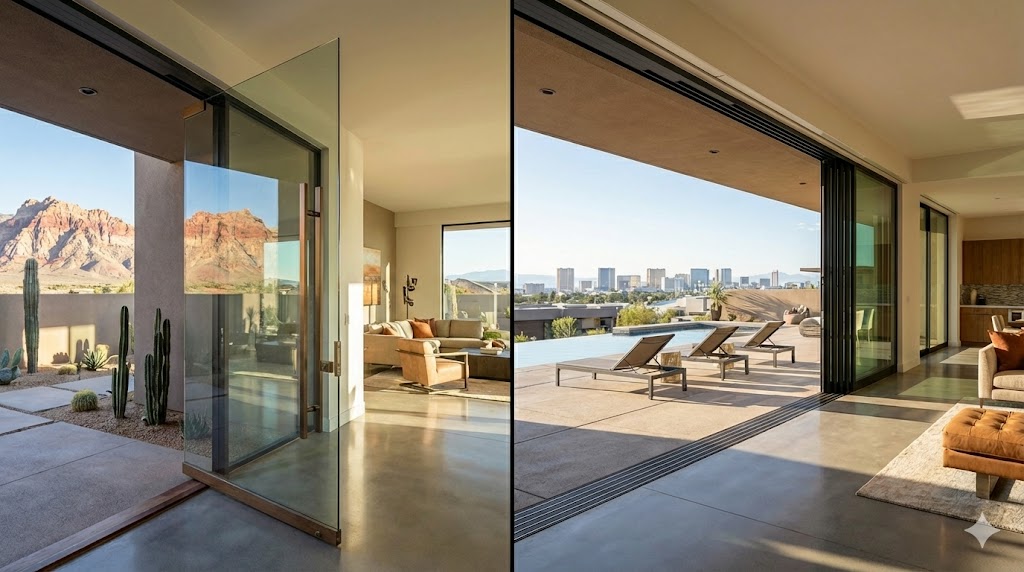
If you’re building or renovating a luxury home in Las Vegas, Henderson, or anywhere in the valley, the door style you choose does more than connect rooms — it defines how your home feels, flows, and performs against the desert climate. Two of the most sought-after options for high-end residential projects are pivot doors and sliding glass doors, and while both deliver a striking visual impact, they serve very different purposes.
Here’s a straightforward comparison to help you determine which option fits your home, your lifestyle, and the demands of living in Southern Nevada.
What Is a Pivot Door?
A pivot door rotates on a central or offset hinge point rather than swinging from the side like a traditional hinged door. This mechanism allows for much larger and heavier door panels — some exceeding 10 feet in height and weighing over 1,000 pounds — while still operating smoothly with minimal effort.
Pivot doors are most commonly used as a dramatic front entry or as a statement transition between interior spaces. They’re available in a range of materials including steel, aluminum, wood, and glass, and they can be fully customized in size, finish, and configuration.
Advantages of Pivot Doors
- Architectural impact — A large pivot door creates an immediate first impression. For luxury homes in communities like The Ridges, Ascaya, or MacDonald Highlands, this kind of entrance sets the tone for the entire property.
- Handles heavy, oversized panels — The pivot mechanism distributes weight across the floor and header rather than relying on side-mounted hinges, making it possible to install massive door panels that would be impractical with standard hardware.
- Smooth operation — Despite their size, well-engineered pivot doors open and close with very little force.
- Custom material and finish options — Pivot doors can be fabricated from Corten steel, blackened metal, natural hardwoods, or floor-to-ceiling glass panels depending on the aesthetic you’re going for.
Drawbacks to Consider
- No insect screening — Most pivot doors do not accommodate integrated screen systems, which can be a consideration during the warmer months when you want airflow without inviting the outdoors inside.
- Limited weather sealing compared to sliders — Because of how the panel rotates, achieving a perfectly airtight seal on all four sides is more challenging. In a climate where you’re running air conditioning eight months out of the year, this matters.
- Higher cost per opening — Pivot doors are typically a single-panel feature. If your goal is to open up an entire wall to your backyard or pool area, the cost per square foot of opening is significantly higher than a multi-panel sliding system.
What Is a Sliding Glass Door System?
Modern sliding glass door systems — particularly multi-panel configurations like lift-and-slide or pocket sliding doors — are engineered to open wide expanses of wall space with floor-to-ceiling glass panels that glide along a track. These are not the basic two-panel patio sliders from the 1990s. Today’s luxury sliding systems can span 40 feet or more with minimal framing, creating a nearly uninterrupted wall of glass.
Advantages of Sliding Glass Doors
- Maximum opening width — Multi-panel sliding systems let you open 20, 30, or even 40+ feet of wall space, effectively erasing the boundary between your indoor living area and your outdoor space. For Las Vegas homes designed around pool areas, covered patios, or strip views, this is the primary draw.
- Superior weather sealing — Lift-and-slide systems in particular create a tight compression seal when locked, which is critical for keeping cooled air inside during the brutal summer months. In a market where energy costs spike between June and September, this performance difference is meaningful.
- Integrated screen options — Many premium sliding systems offer retractable screen tracks that allow ventilation during the milder fall and spring months without compromising on insects or debris.
- Flush threshold options — Recessed sill tracks can create a seamless floor transition between indoor and outdoor spaces, which is both an aesthetic and accessibility benefit.
- Scalability — You can configure a sliding system with two panels or twelve. The flexibility to match virtually any wall opening makes these systems adaptable to new construction and renovation projects alike.
Drawbacks to Consider
- Track maintenance — Desert dust, sand, and debris can accumulate in the floor track over time. Regular cleaning is necessary to keep the panels gliding smoothly, though quality systems are designed with this in mind.
- Less dramatic as a single entry point — If you’re looking for one bold front door moment, a sliding system doesn’t deliver the same singular visual punch as an oversized pivot door.
- Floor track visibility — Even with recessed options, there will be a visible track in the floor plane. For some design-conscious homeowners, this is a minor but notable tradeoff.
How Each Performs in the Las Vegas Desert Climate
This is where the comparison really matters for local homeowners. Living in a climate that regularly hits 110°F+ in summer and deals with wind-driven dust, UV exposure, and extreme temperature swings places specific demands on your doors.
Heat and energy efficiency: Sliding glass door systems — especially those with thermally broken aluminum frames, Low-E coatings, and argon-filled insulated glass units — generally outperform pivot doors in terms of energy retention. The compression seal on a lift-and-slide system keeps conditioned air inside more effectively than the perimeter seal on most pivot doors. When your July electric bill is the difference, this is a practical consideration, not just a technical one.
UV and sun exposure: Both door types can be specified with high-performance glass that blocks UV rays while still allowing natural light. For west-facing openings — common in Las Vegas homes positioned to capture strip or mountain views — specifying the right glass package is essential regardless of which door style you choose.
Dust and sand: The valley’s fine particulate dust affects both options differently. Pivot doors with tight perimeter gaskets can be effective at keeping dust out when closed, but the gap created during operation allows ingress. Sliding systems with well-maintained tracks and quality weatherstripping tend to perform consistently, though the track itself requires periodic cleaning.
Wind resistance: Las Vegas wind events can produce sustained gusts. Multi-panel sliding systems rated for wind load are generally more rigid under pressure due to their track-mounted design, while pivot doors — especially very large ones — can be susceptible to wind catch if not properly specified.
When to Choose a Pivot Door
A pivot door is the right call when you want a singular architectural statement. If your project includes a grand entry, a transition between a foyer and a great room, or a private courtyard access point where the door itself is the design feature, a pivot door delivers something a slider simply cannot.
They also work well when the opening width is moderate — typically a single panel between 4 and 6 feet wide — and the priority is visual drama over maximum openness.
When to Choose a Sliding Glass Door System
Go with a sliding system when the goal is to maximize the connection between indoor and outdoor living spaces. If you’re designing around a pool, an outdoor kitchen, a covered patio with a fireplace, or a living room that frames the Las Vegas valley, a multi-panel sliding system gives you the widest possible opening with the best energy performance.
This is also the practical choice for everyday livability. Sliding doors are easier to operate daily, integrate better with screen systems, and seal tighter against the elements — all factors that matter when you’re living in a home year-round, not just admiring it from the curb.
Can You Use Both?
Absolutely — and many of the best-designed luxury homes in the valley do exactly that. A striking pivot door at the front entry establishes presence and personality, while a multi-panel sliding system at the rear of the home opens the living space to the outdoors. The two serve different functions and complement each other well when the design is cohesive.
Choosing the Right System for Your Project
The right door depends on the specific opening, the orientation of the wall, your energy goals, and how you actually live in the space. At Desert Luxury, we work with homeowners, architects, and builders throughout Las Vegas and Henderson to specify and install both pivot doors and sliding glass door systems from manufacturers like Fleetwood that are engineered for performance in the desert climate.
If you’re weighing your options or ready to move forward with a project, contact our team for a consultation. We’ll walk through your plans, discuss what makes sense for each opening, and make sure the finished product performs as well as it looks.